1/4
Paschimottānāsana — The Pose Your Spine Has Been Waiting For
Paschimottānāsana (Seated Forward Bend) — the forward fold your body already knows from tying your shoelaces. This 4-card set covers Sanskrit etymology (paschima = west / back body, uttāna = intense stretch), physical and emotional benefits, age-group guidance for all four groups, the PASCHI = West mnemonic, and a no-mat desk-chair practice grounded in Yoga Sūtras 2.47 — Prayatna-śaithilyānanta-samāpattibhyām.
2026. 6. 10. · 18:37
갤러리
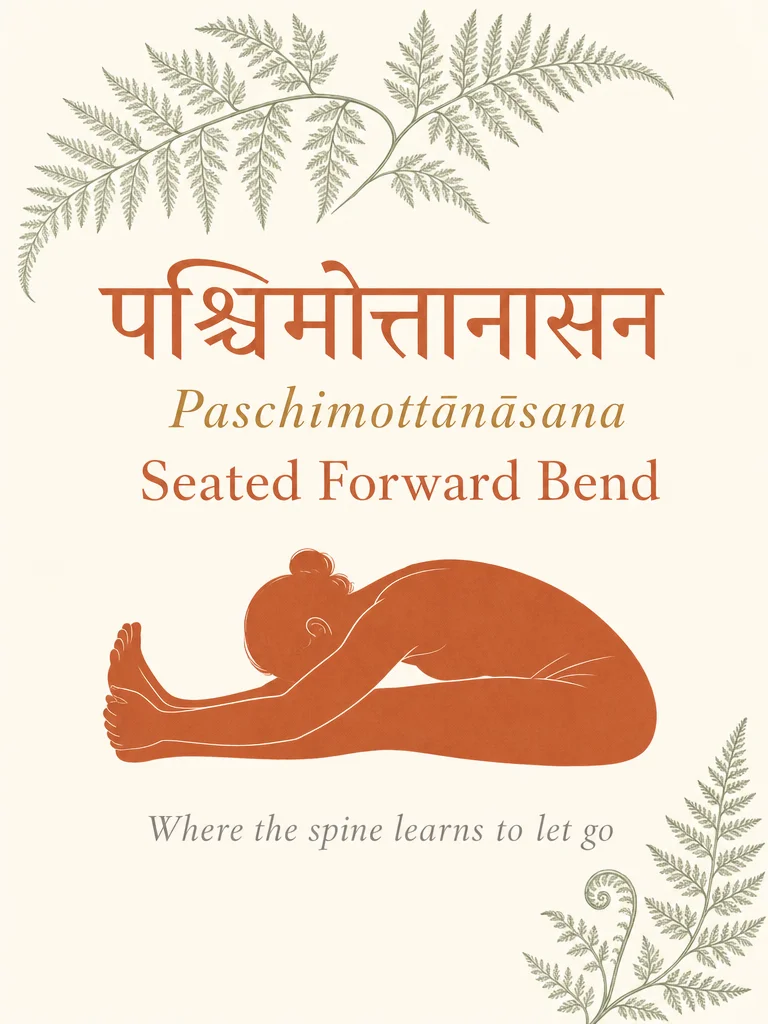
पश्चिमोत्तानासन — Paschimottānāsana
Seated Forward Bend | The pose your spine has been waiting for since you sat down
Paschimottānāsana is deceptively quiet. You sit, you fold forward, you breathe. That is the whole thing — and yet it is one of the most complete poses in the classical tradition. The name tells you exactly what is happening: Paschima (पश्चिम) means "west" — in yogic geography, the back of the body faces west when you stand facing the rising sun. Uttāna (उत्तान) means "intense stretch." This pose stretches your entire western self: every inch of the spine's back surface, the hamstrings, the calves, the neck.
The Sanskrit root
| Sanskrit | Script | Meaning |
|---|---|---|
| Paschima | पश्चिम | West / back of the body |
| Uttāna | उत्तान | Intense stretch |
| Āsana | आसन | Posture, seat |
Together: the intense stretch of the entire back body.
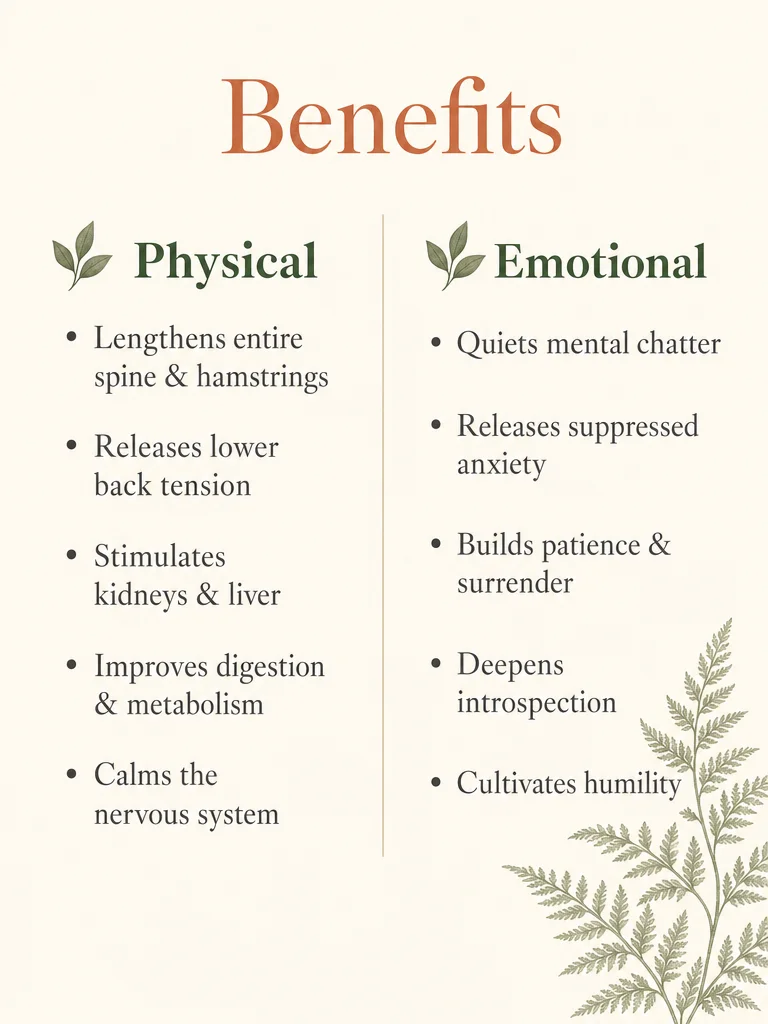
Card 2 — Benefits
Physical
- Lengthens the entire spine and hamstrings in one continuous line
- Releases chronic lower-back tension caused by prolonged sitting
- Stimulates the kidneys, liver, and abdominal organs through gentle compression
- Improves digestion and reboots sluggish metabolism
- Calms the nervous system by activating the parasympathetic response
Emotional & mental
- Quiets mental chatter — the forward fold closes off visual input and turns attention inward
- Releases suppressed anxiety held in the hip flexors and lumbar
- Builds patience and the capacity to surrender without force
- Deepens introspection; this is traditionally a pose for pratyāhāra (sense withdrawal)
- Cultivates humility — you bow to your own body's current limit
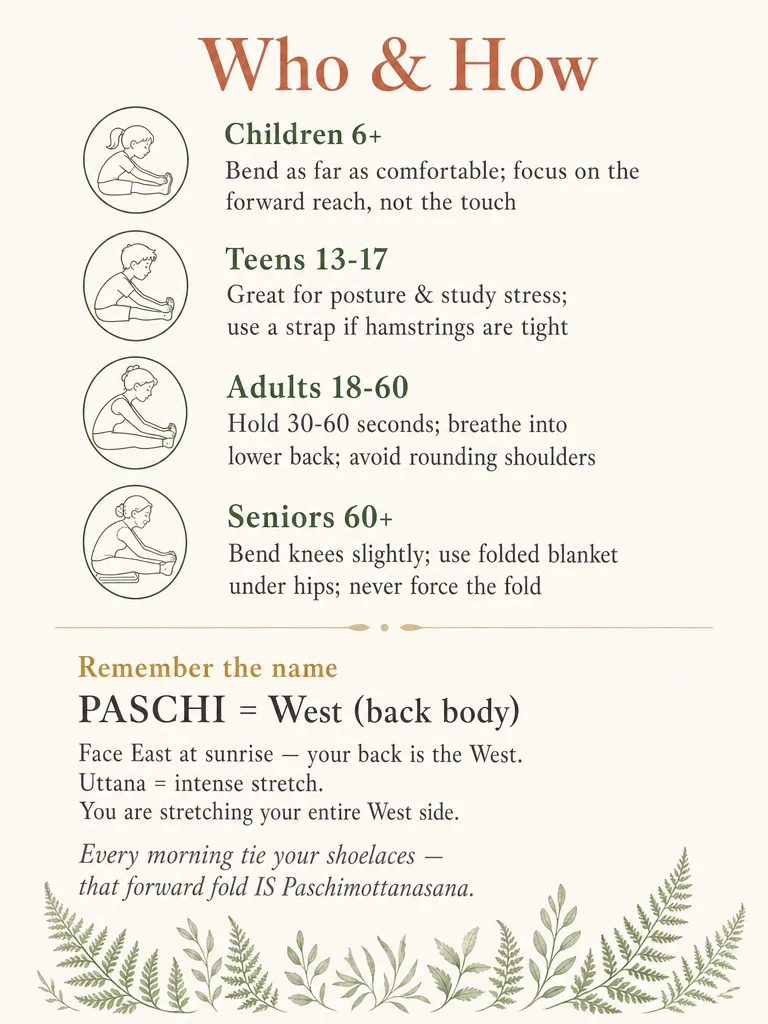
Card 3 — Age-group guidance
Children (6+)
Encourage the reach rather than the touch. The goal is not to grab the feet — it is to feel the spine lengthen. Make it playful: pretend to reach for something just beyond the toes.
Teens (13–17)
Excellent for releasing study-posture stress and tight hamstrings from sport. Use a yoga strap or a folded belt looped around the feet to avoid rounding the upper back.
Adults (18–60)
Hold for 30–60 seconds; breathe into the lower back with each exhale. Keep the sitting bones grounded. Avoid collapsing the shoulders — lead from the sternum, not from the neck.
Seniors (60+)
Bend the knees generously. Sit on a folded blanket to tilt the pelvis forward. Never force the forward fold — the value is in the gentle traction on the spine, not in reaching the feet.
Cautions for all: Avoid if you have a herniated disc, sciatica flare-up, or recent hamstring tear. In pregnancy, modify with wide-leg forward fold after the first trimester.
Mnemonic: PASCHI = West
Face east at sunrise — your back body faces west. Paschimottānāsana stretches that entire west side from heel to head. Once you know you are "stretching the west," the name never leaves you.
The real-world moment
Every morning when you tie your shoelaces — that forward fold over your extended leg is Paschimottānāsana. You have been doing this pose since childhood. The mat just makes it conscious.
Card 4 — Sanskrit quote
प्रयत्नशैथिल्यानन्तसमापत्तिभ्याम्
Prayatna-śaithilyānanta-samāpattibhyām
— Yoga Sūtras 2.47, Patañjali
"Mastery of posture comes through releasing effort and merging with the infinite."
Patañjali was describing exactly this: Paschimottānāsana is not won by pushing harder into the fold. It opens when you stop fighting the limit and let the breath do the work. The pose that asks the most effort is the one that asks you to stop trying.
Today's take-home practice
Next time you sit at your desk, slide to the edge of your chair. Extend both legs out in front of you, feet flexed. Reach your hands toward your shins and hold for five slow breaths. Feel the pull along the back of both legs and the length it creates in your lower back. That is Paschimottānāsana — no mat, no studio, no special clothes. Just you, your spine, and five breaths pointing west.
Pragya Yoga posts one asana or yoga tip each day — practical wisdom you can carry into an ordinary moment.
댓글