India's Fastest-Growing Startups: Issue #2 — Four Companies Building Durable Positions

India's Fastest-Growing Startups: Issue #2 — Four Companies Building Durable Positions

Issue #2 profiles Kuku FM (confidential IPO filing at ₹15,000 Cr valuation, FY26 revenue ~₹1,400 Cr), TrueFan AI ($10M Series A, 20M AI-generated videos/year for Bajaj Finance and Zomato), Nobel Hygiene (profitable adult diaper market leader, $300M IPO), and Rapido ($240M Series F at $3B, FY25 revenue ₹934 Cr). The common thread: each company occupied a structural gap incumbents ignored and built durable moats before the capital arrived.

India's startup ecosystem in 2026 is running two stories simultaneously. The loud story is capital: $240M raises, IPO filings, unicorn headlines. The quieter one is more interesting — a cohort of companies that survived lean fundraising years by finding structural pockets most investors overlooked, then building deep enough that the market couldn't ignore them. This issue covers four of those companies: an audio platform that became India's first mainstream vernacular subscription business, an enterprise video infrastructure company that pivoted at the right moment, a hygiene brand with an aging-population tailwind and half the adult diaper market, and a ride-hailing platform that out-priced Uber by two-wheeling India's commute problem.
Three are heading toward IPOs. All four are growing on fundamentals, not just funding.

Kuku FM: from niche to ₹15,000 Cr valuation

Kuku FM, founded in 2018 under parent entity Kuku Technologies, has pulled off something most Indian media companies couldn't: convert tens of millions of free listeners into paying subscribers at scale, entirely through vernacular content.
The numbers are striking. Operating revenue rose to ₹242 Cr in FY25, up 175% from ₹88 Cr in FY24 — itself a 114% jump from the year before. 1 By FY26, the company crossed ₹1,400 Cr in revenue (a near-7x jump year on year), approaching breakeven for the first time. 2 The platform now has 10 million+ active paid subscribers — an 11% paid conversion rate that ranks among the highest for any OTT platform globally. Total app downloads across Kuku FM and its short-drama spinoff Kuku TV: over 400 million.
The business model is straightforward in structure, sophisticated in execution. Revenue is almost entirely subscription-driven, with monthly and annual tiers. Beyond audio, Kuku launched Kuku TV in late 2024 — vertical-format short dramas (think ReelShort, but in Hindi, Tamil, and Telugu) that generated 200M+ downloads and now ship 150+ original shows per month. AI-assisted production workflows compress content creation costs while maintaining volume. The economics of content, in other words, have tilted in Kuku's favor.
Where the growth came from: Kuku found its users not in urban metros but in the Tier-2 and Tier-3 towns that Spotify and Audible never meaningfully reached. Commuters, homemakers, and daily-wage workers who didn't read English and couldn't afford premium entertainment — but could pay ₹99/month for audio books, motivational content, and drama in their own language. That demographic is 400+ million people and still largely unserved by global platforms.
The moat: Content flywheel plus distribution depth. Kuku owns its IP, invests only in formats that internal analytics confirm generate high completion rates, and licenses popular titles to film producers (an emerging B2B revenue stream that started in 2026). The platform's creator payout model ties earnings to subscriber retention, giving content creators a direct incentive to produce material people actually finish.
The IPO signal: On June 4, 2026, Kuku Technologies confidentially filed a Draft Red Herring Prospectus (DRHP) with SEBI for an IPO targeting ₹3,500 Cr in fundraising at a ₹15,000 Cr (~$1.8B) valuation — led by Kotak Mahindra Capital, Jefferies, JM Financial, and Axis Capital. 2 The proceeds are earmarked for AI infrastructure, content production, and geographic expansion. MS Dhoni is among the investors.
正在加载统计卡片…
The risk to watch: FY25 marketing spend was ₹285 Cr — more than the entire revenue. Losses widened 59% even as revenue tripled. The IPO will be a test of whether public markets are willing to bet on Kuku's path to profitability, or whether the margin story needs to improve first.

TrueFan AI: the enterprise video infrastructure bet

When Nimish Goel and Devender Bindal founded TrueFan in 2020, it was a celebrity fan-engagement app — users could buy personalized shoutouts from Bollywood stars. By 2026, that company barely resembles itself. TrueFan AI is now an enterprise video infrastructure platform processing 20 million AI-generated videos per year for companies like Bajaj Finance, Zomato, HDFC Bank, and Cipla.
The pivot worked because Goel and Bindal saw what no fan-tech company wanted to admit: the actual value wasn't in celebrities, it was in the underlying technology of making a person's recorded image say and do things at scale. That capability, applied to enterprise communications instead of fan interactions, became a different business entirely.
On June 4, 2026, TrueFan AI closed a $10M Series A led by Baring Private Equity Partners India and Z3Partners, with participation from IAN Alpha Fund and 3Lines Venture Capital. 3 The earlier seed round ($4.3M from Ronnie Screwvala, Saama Capital, and Mayfield India) predated the pivot.
What it actually does: TrueFan AI turns a single 5-minute video recording of a brand ambassador, dealer executive, or company leader into thousands of personalized contextual videos — localized across 175+ languages, adapted for different audiences, and distributable at up to 500,000 videos per minute via CRM, WhatsApp, or RCS integrations. 4 The use cases span dealer network communication (think FMCG companies sending regional managers personalized quarterly briefs), digital marketing (ad variations without repeat shoots), and learning & development.
The company claims 110 enterprise clients — 45% of which came through inbound. Revenue model is contract-based with minimum video volume commitments, meaning revenue is recurring and predictable once a client is onboarded.
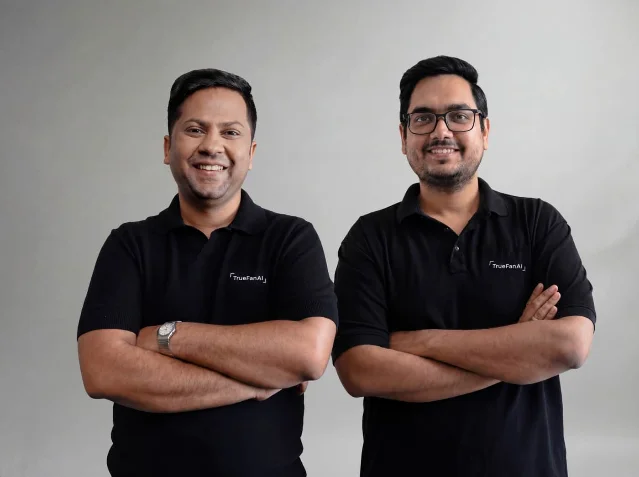
TrueFan AI co-founders Nimish Goel and Devender Bindal
TrueFan AI founders Nimish Goel and Devender Bindal 3
Where the defensibility lies: Two places. First, proprietary video model quality — TrueFan claims its avatars (it has built AI avatars for 150+ celebrities including Shah Rukh Khan, Ranveer Singh, and Rohit Sharma) are already deeply embedded in client workflows, generating switching costs once integrated into CRM systems. Second, the celebrity/persona library: building a high-quality avatar requires consent, calibration, and approval workflows that competitors can't replicate quickly.
Baring PE's Arul Mehra put it plainly: "The infrastructure for large-scale enterprise video communication simply hasn't existed until recently." 3
Outlook: TrueFan is building real-time AI video agents — systems that can conduct interactive conversations in video format rather than just push pre-recorded content. The capital will fund international expansion (Southeast Asia, Middle East, US) and AI infrastructure. Global competitors include Synthesia (UK) and HeyGen (US), but TrueFan's India-first enterprise relationships and sub-100ms language localization may give it a regional edge.

Nobel Hygiene: the profitable holdout

While most of this issue's other companies are loss-making and racing toward profitability, Nobel Hygiene has a different problem: figuring out how to publicly list a business that's already healthy.
Founded in 2000 by Kamal Johari, Nobel Hygiene is India's largest disposable hygiene brand — its adult diaper brand Friends holds ~50% market share in India's adult diaper segment. 5 Baby diapers (Teddyy, Snuggy) and women's hygiene (Rio) round out the portfolio. The company exports to 30+ countries.
FY25 revenue reached ~₹800 Cr, with the company running profitably — a rarity in India's consumer startup space. 6 Total funding raised: ~$68M, from Quadria Capital (healthcare PE), Sixth Sense Ventures, and Neo Asset Management (which invested ₹170 Cr in May 2025). 7
On June 6, 2026, Nobel Hygiene filed special resolution filings to change its name from "Nobel Hygiene Private Limited" to "Nobel Hygiene Limited" — a regulatory step that signals imminent IPO preparations. Reports put the planned offering at ~$300M (~₹2,500 Cr), structured as a mix of fresh shares and an offer-for-sale component. 7
The growth story is structural, not operational. India has one of the fastest-growing elderly populations globally — the 60+ cohort is projected to nearly double to 340 million by 2050. Adult incontinence products remain severely under-penetrated outside urban areas. Awareness campaigns, modern retail distribution, and e-commerce have expanded the category faster than GDP. Nobel's Friends brand benefits from both the supply-side expansion (more distribution channels) and the demand-side shift (increasing social acceptance). The company operates with 1,000+ dealers and distributors pan-India.
The competitive moat: Brand trust in an intimate category is hard to dislodge. Friends has 25 years of distribution relationships, clinical validation, and consumer loyalty in a segment where switching is emotionally costly. International FMCG giants (Kimberly-Clark, P&G) have attempted India market entries repeatedly but have not dethroned the local incumbents in this segment.
Risk: Nobel Hygiene's growth rate, while consistent, is slower than the other companies in this issue. The ₹800 Cr FY25 revenue reflects steady compound growth rather than a breakout inflection. The IPO valuation depends on whether public markets ascribe a premium for the FMCG-style earnings quality, or penalize the company for slower growth relative to digital-first peers.

Rapido: the ₹25,000 Cr mobility thesis

Rapido exists because Uber and Ola built for one segment of India's commute market — mid-distance cab rides for urban middle-class users — and left everyone else underserved. Rapido co-founders Aravind Sanka, Pavan Guntupalli, and Rishikesh SR bet on a different unit: the 3-8 km urban trip that's too far to walk and too expensive by taxi. Their answer was bike taxis, autorickshaws, and eventually a full platform.
That bet has validated. In May 2026, Rapido raised $240M in a Series F led by Prosus, with WestBridge Capital and Accel participating, at a $3B valuation — part of a $730M combined primary and secondary deal. 8 Uber's own global CEO has publicly named Rapido as Uber's toughest competitor in India.
The financials show real operating leverage. FY25 revenue from operations: ₹934 Cr, up 44% from ₹648 Cr in FY24. 9 Total income crossed ₹1,003 Cr. Net loss narrowed 30.5% to ₹258 Cr from ₹371 Cr — EBITDA margin improving from approximately -40% in FY23 to -19.6% in FY25. An IPO is targeted for late 2026.
How the model works: Rapido operates a dual-mode for drivers ("Captains"): a per-trip commission (10-15%), or a fixed daily subscription that lets drivers keep the entire fare. The subscription model provides Rapido with predictable income while incentivizing drivers to take more rides. The delivery arm (food, packages) now contributes ₹339 Cr of the ₹934 Cr top line — diversification that reduces dependency on any single category.
The platform counts 9 million+ active drivers across 400+ cities. Supply density at this scale becomes its own barrier: competitors would need to match driver acquisition spend across hundreds of cities simultaneously, which is expensive.
The second-city thesis: 65% of India's urban population lives in Tier-2 and Tier-3 cities. These markets have low formalized mobility penetration, lower-income commuters who are extremely price-sensitive, and road infrastructure that makes two-wheelers more practical than cars. Rapido's core pricing (₹20-60 for a typical trip vs. ₹150-200 by cab) speaks directly to that user. The company's next expansion push — funded partly by the Series F — targets deeper penetration of these markets and expansion of Ownly, its food delivery arm.
正在加载图表…

What ties these four together

Each of these companies found a specific structural gap: the 800 million Indians who consume media in regional languages, the enterprise video production bottleneck that inflates Fortune-500 marketing budgets, the aging-population hygiene need that global brands underestimated, the commuter who earns ₹500/day and can't spend ₹200 on a cab ride. None of these gaps required new technology to unlock — they required patience and depth.
The resulting businesses share a common quality: their growth is harder to replicate than their surface product suggests. Kuku FM's 6,000+ hours of localized content library took years to build. TrueFan AI's avatar consent workflows and CRM integrations create exit costs. Friends' 25-year distribution network and brand trust in an intimate product category take decades to build. Rapido's 9 million drivers have calibrated their income expectations around the platform.
This is the pattern that India's most durable 2026 startups share: they didn't disrupt an industry — they occupied a specific part of it that the incumbents ignored, then dug in.
Issue #3 candidates on the radar: IndiGrid-class infrastructure plays, India-born B2B SaaS companies approaching $100M ARR, and the emerging agritech players quietly building farmer credit networks.

围绕这条内容继续补充观点或上下文。

  • 登录后可发表评论。